
Back to Course
Math 8th grade
-
Repeating decimals3 Topics|3 Quizzes
-
Square roots & cube roots5 Topics|6 Quizzes
-
Irrational numbers3 Topics|2 Quizzes
-
Approximating irrational numbers4 Topics|3 Quizzes
-
Exponents with negative bases6 Topics|3 Quizzes
-
Exponent properties intro3 Topics|4 Quizzes
-
Negative exponents2 Topics|1 Quiz
-
Exponent properties (integer exponents)2 Topics|2 Quizzes
-
Working with powers of 102 Topics|2 Quizzes
-
Scientific notation intro2 Topics|1 Quiz
-
Arithmetic with numbers in scientific notation4 Topics|2 Quizzes
-
Scientific notation word problems3 Topics|1 Quiz
-
Equations with variables on both sides4 Topics|2 Quizzes
-
Equations with parentheses1 Topic|2 Quizzes
-
Number of solutions to equations4 Topics|2 Quizzes
-
Equations word problems2 Topics|1 Quiz
-
Graphing proportional relationships2 Topics|1 Quiz
-
Solutions to linear equations4 Topics|2 Quizzes
-
Intercepts5 Topics|2 Quizzes
-
Slope8 Topics|3 Quizzes
-
Intro to slope-intercept form2 Topics|1 Quiz
-
Writing slope-intercept equations5 Topics|2 Quizzes
-
Functions7 Topics|3 Quizzes
-
Linear models7 Topics|3 Quizzes
-
Comparing linear functions6 Topics|1 Quiz
-
Constructing linear models for real-world relationships5 Topics|1 Quiz
-
Recognizing functions9 Topics|2 Quizzes
-
Testing if a relationship is a function
-
Relations and functions
-
Recognizing functions from graph
-
Checking if a table represents a function
-
Recognizing functions from table
-
Checking if an equation represents a function
-
Does a vertical line represent a function?
-
Recognizing functions from verbal description
-
Recognizing functions from verbal description word problem
-
Testing if a relationship is a function
-
Linear and nonlinear functions5 Topics|2 Quizzes
-
Intro to systems of equations3 Topics|1 Quiz
-
Solving systems with substitution6 Topics|1 Quiz
-
Systems of equations with substitution: 2y=x+7 & x=y-4
-
Systems of equations with substitution: y=4x-17.5 & y+2x=6.5
-
Systems of equations with substitution: -3x-4y=-2 & y=2x-5
-
Systems of equations with substitution: 9x+3y=15 & y-x=5
-
Systems of equations with substitution: y=-5x+8 & 10x+2y=-2
-
Systems of equations with substitution: y=-1/4x+100 & y=-1/4x+120
-
Systems of equations with substitution: 2y=x+7 & x=y-4
-
Number of solutions to systems of equations5 Topics|1 Quiz
-
Systems of equations number of solutions: fruit prices (1 of 2)
-
Solutions to systems of equations: dependent vs. independent
-
Number of solutions to a system of equations
-
Number of solutions to a system of equations algebraically
-
How many solutions does a system of linear equations have if there are at least two?
-
Systems of equations number of solutions: fruit prices (1 of 2)
-
Systems of equations word problems7 Topics|2 Quizzes
-
Angles between intersecting lines4 Topics|3 Quizzes
-
Triangle angles7 Topics|3 Quizzes
-
Pythagorean theorem3 Topics|4 Quizzes
-
Pythagorean theorem application4 Topics|5 Quizzes
-
Pythagorean theorem and distance between points1 Topic|1 Quiz
-
Pythagorean theorem proofs4 Topics
-
Volume3 Topics|4 Quizzes
-
Transformations intro3 Topics|1 Quiz
-
Translations3 Topics|1 Quiz
-
Rotations2 Topics|2 Quizzes
-
Reflections3 Topics|1 Quiz
-
Properties & definitions of transformations3 Topics|3 Quizzes
-
Dilations5 Topics|2 Quizzes
-
Congruence and similarity4 Topics|2 Quizzes
-
Introduction to scatter plots1 Topic|1 Quiz
-
Interpreting scatter plots2 Topics|2 Quizzes
-
Estimating lines of best fit4 Topics|3 Quizzes
-
Two-way tables3 Topics|4 Quizzes
Deprecated: is_quiz_accessable is deprecated since version 3.4.0! Use learndash_is_quiz_accessable instead. in /home/succes48/successtutoring.us/wp-includes/functions.php on line 5213
Time limit: 0
Quiz Summary
0 of 10 Questions completed
Questions:
Information
You have already completed the quiz before. Hence you can not start it again.
Quiz is loading…
You must sign in or sign up to start the quiz.
You must first complete the following:
Results
Quiz complete. Results are being recorded.
Results
0 of 10 Questions answered correctly
Your time:
Time has elapsed
You have reached 0 of 0 point(s), (0)
Earned Point(s): 0 of 0, (0)
0 Essay(s) Pending (Possible Point(s): 0)
Categories
- Not categorized 0%
- 1
- 2
- 3
- 4
- 5
- 6
- 7
- 8
- 9
- 10
- Current
- Review
- Answered
- Correct
- Incorrect
-
Question 1 of 10
1. Question
Hüseyin was able to map quadrilateral E F G H onto E J G K using a vertical stretch.
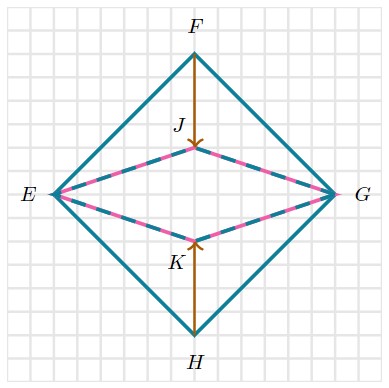
Hüseyin concluded:
“I was able to map quadrilateral E F G H onto quadrilateral E J G K using a sequence of rigid transformations and dilations, so the figures are similar.”
What error did Hüseyin make in his conclusion?
Choose 1 answer:
CorrectIncorrect -
Question 2 of 10
2. Question
Bastian was able to map quadrilateral O P Q R onto O N M L using a reflection and a dilation.
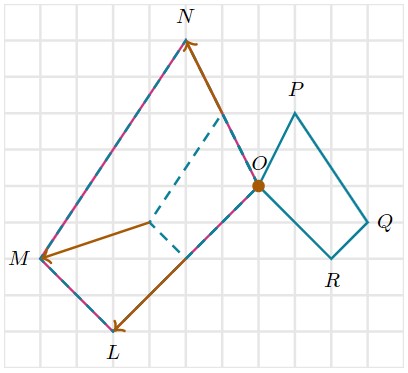
Bastian concluded:
“I was able to map quadrilateral O P Q R onto quadrilateral O N M L using a sequence of rigid transformations and dilations, so the figures are similar.”
What error did Bastian make in his conclusion?
Choose 1 answer:
CorrectIncorrect -
Question 3 of 10
3. Question
Pedro was curious if circles A and B (with X and Y being on each circle, respectively) were similar, so he tried to map one figure onto the other using rigid transformations.
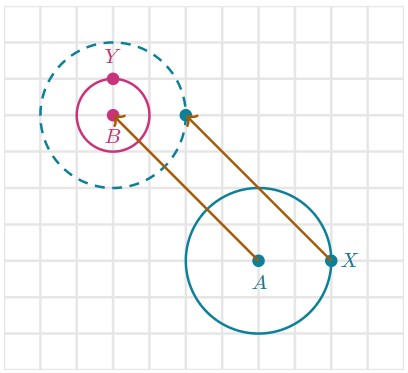
Pedro concluded:
“It’s not possible to map circle A onto circle B using a sequence of rigid transformations, so the circles are not similar.”
What error did Pedro make in his conclusion?
Choose 1 answer:
CorrectIncorrect -
Question 4 of 10
4. Question
Timo was curious if quadrilaterals L M N R and P Q N O were similar, so he tried to map one figure onto the other using a rotation and a dilation.
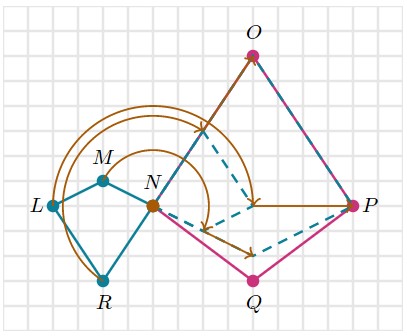
Timo concluded:
“It’s not possible to map L M N R onto P Q N O using a sequence of rigid transformations and dilations, so the quadrilaterals are not similar.”
What error did Timo make in his conclusion?
Choose 1 answer:
CorrectIncorrect -
Question 5 of 10
5. Question
Eleanor was curious if triangles △DEF and △GHI were similar, so she tried to map one figure onto the other using rigid transformations.
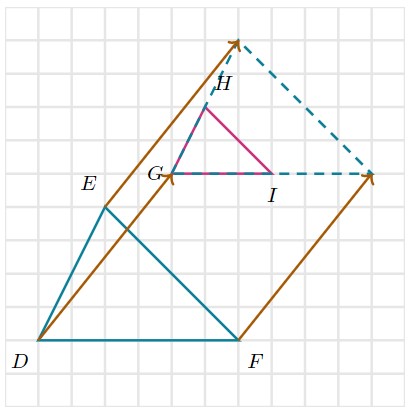
Eleanor concluded:
“It’s not possible to map △DEF onto △GHI using a sequence of rigid transformations, so the triangles are not similar.”
What error did Eleanor make in her conclusion?
Choose 1 answer:
CorrectIncorrect -
Question 6 of 10
6. Question
Lennox was curious if △ABE and △DCE were similar, so she tried to map one figure onto the other using a reflection and a dilation.
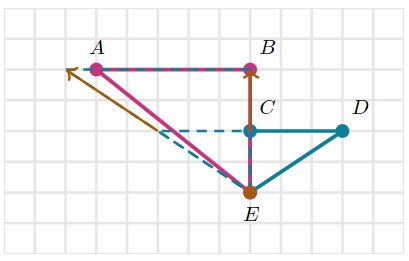
Lennox concluded:
“It’s not possible to map △DCE onto △ABE using a sequence of rigid transformations and dilations, so the triangles are not similar.”
What error did Lennox make in her conclusion?
Choose 1 answer:
CorrectIncorrect -
Question 7 of 10
7. Question
Erin was able to map line segment \overline A \overline B onto line segment \overline C \overline B using a rotation and a dilation.
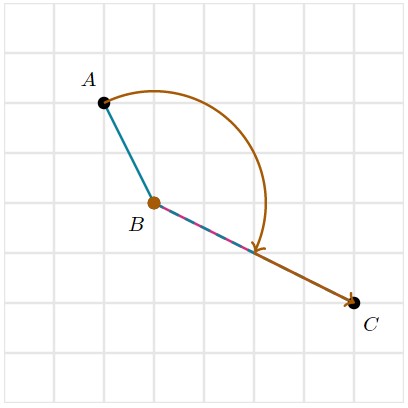
Erin concluded:
“I was able to map line segment \overline A \overline B onto line segment \overline C \overline B using a sequence of rigid transformations and dilations, so the figures are similar.”
What error did Erin make in her conclusion?
Choose 1 answer:
CorrectIncorrect -
Question 8 of 10
8. Question
Sabrina was able to map circle P onto circle R (with Q and S being on each circle, respectively) using a translation and a dilation.

Sabrina concluded:
“I was able to map circle P onto circle R using a sequence of rigid transformations and a dilation, so the figures are similar.”
What error did Sabrina make in her conclusion?
Choose 1 answer:
CorrectIncorrect -
Question 9 of 10
9. Question
Konnor was curious if quadrilaterals STUV and W X Y Z were similar, so he considered their angles.
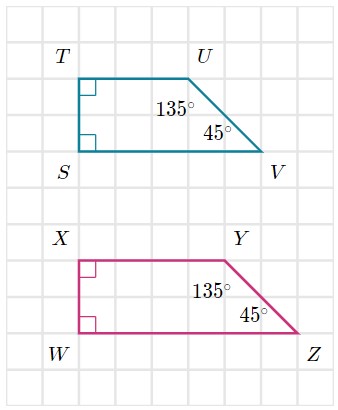
Konnor concluded:
“The quadrilaterals have four pairs of congruent corresponding angles, so the figures are similar.”
What error did Konnor make in his conclusion?
Choose 1 answer:
CorrectIncorrect -
Question 10 of 10
10. Question
Casey was able to map line segment \overline U \overline V onto line segment \overline S \overline T using a translation and a rotation.
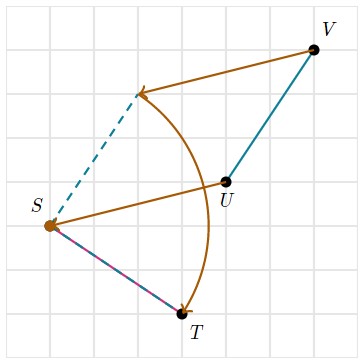
Casey concluded:
“I was able to map line segment \overline U \overline V onto line segment \overline S \overline T using a sequence of rigid transformations without a dilation, so the figures are congruent but they are not similar.”
What error did Casey make in her conclusion?
Choose 1 answer:
CorrectIncorrect